
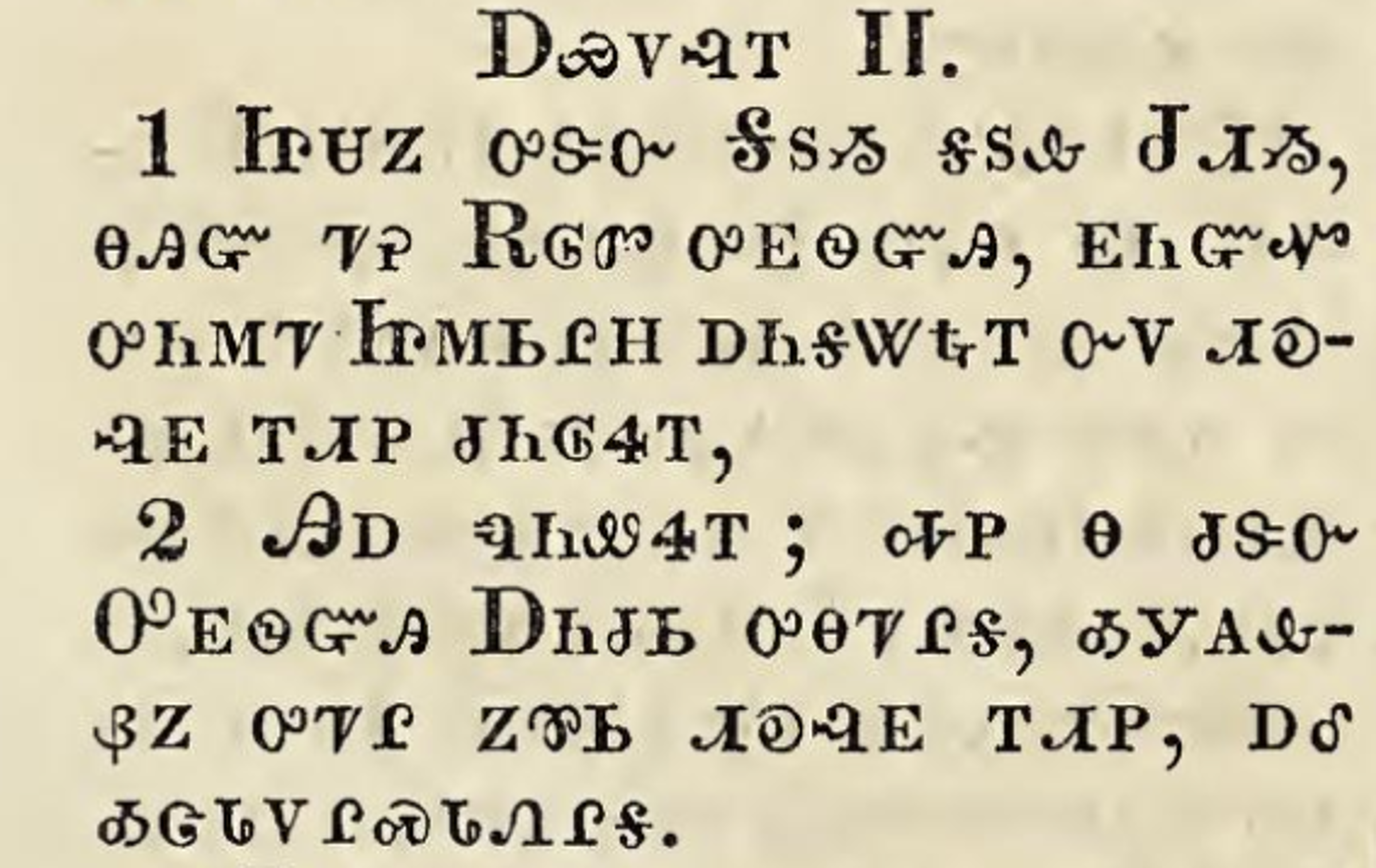
© Cherokee (1860) New Testament: © Cherokee (1860) New Testament: https://archive.org/details/CHRCNT_DBS_HS/page/n3/mode/2up
- Language:
- Cherokee
- Place of origin:
- North America, Georgia, New Echota, GA
- Time of origin:
- 1829
- Transcription:
- ᏥᏌᏃ ᎤᏕᏅ ᎦᏚᏱ ᎦᏚᎲ ᏧᏗᏱ, ᎾᎯᏳ ᏤᎮ ᎡᎶᏛ ᎤᎬᏫᏳᎯ, ᎬᏂᏳᏉ ᎤᏂᎷᏤ ᏥᎷᏏᎵᎻ ᎠᏂᎦᏔᎿᎢ ᏅᏙ ᏗᎧᎸᎬ ᎢᏗᏢ ᏧᏂᎶᏎᎢ,
ᎯᎠ ᏄᏂᏪᏎᎢ; ᎭᏢ Ꮎ ᏧᏕᏅ ᎤᎬᏫᏳᎯ ᎠᏂᏧᏏ ᎤᎾᏤᎵᎦ, ᎣᎩᎪᎲᏰᏃ ᎤᏤᎵ ᏃᏈᏏ ᏗᎧᎸᎬ ᎢᏗᏢ, ᎠᎴ ᎣᏣᏓᏙᎵᏍᏓᏁᎵᎦ. - Translation:
- Now when Jesus was born in Bethlehem of Judaea in the days of Herod the king, behold, there came wise men from the east to Jerusalem,
Saying, Where is he that is born King of the Jews? for we have seen his star in the east, and are come to worship him.
(Matthew 2:1-2, King James Version) - Contact person:
- Dr. Sam Kennerley
Additional Information:
The Cherokee script was created between c.1808 and 1821 by a member of that Nation, Sequoyah (c.1770-1843), who was otherwise illiterate. Sequoyah began his attempt at a script with pictograms and logograms, but eventually settled on a syllabic system of 86 characters which represented the full range of sounds in Cherokee. His system was lightly adapted by Elias Boudinot and Samuel Worcester, who set up a press in Cherokee town of New Echota to print texts in that language. Their work included the Cherokee Phoenix, the first newspaper aimed at a Native American audience, as well as a Cherokee translation of the Bible, part of which is depicted here from a later edition printed in New York in 1860. Sequoyah’s invention forms the basis of the modern Cherokee script, and it may even have inspired the creation of other non-Roman scripts such as Cree in the nineteenth and twentieth centuries.
Click here to get back to game!